
Lower-limb oedema explained: why legs swell, what helps, and when to worry
A practical guide for patients, carers and community rehabilitation professionals | Physio at Home
Swollen ankles, feet and legs are common, particularly in older adults, people who spend long periods sitting, and those with reduced mobility. Sometimes the cause is relatively straightforward: fluid collects in the lower legs because someone has been sitting in a chair for several hours and their calf muscles are not working effectively. On other occasions, swelling may be a sign of heart failure, kidney disease, a blood clot, infection or another medical problem that needs investigation.
The challenge is that different conditions can produce very similar-looking swollen legs. Two people may have swelling around both ankles, but one may benefit from walking, ankle exercises and elevation, while the other may need urgent medical assessment and treatment for fluid overload. Someone with chronic venous disease may benefit from compression stockings, whereas another person needs their circulation assessed before compression is considered.
This guide explains what oedema is, why it happens, how to recognise common patterns, what different treatments actually achieve, and when swelling needs medical attention. It is intended to help you understand the possibilities and make safer decisions, rather than diagnose the cause from appearance alone.
1. First, what exactly is oedema?
Oedema is the medical term for an abnormal accumulation of fluid in the body's tissues. Although it can occur in many parts of the body, including the hands, face and abdomen, lower-limb oedema refers to fluid accumulating in the feet, ankles and legs.
To understand why it happens, imagine that your blood vessels are a network of tiny pipes supplying the body's tissues. Blood carries oxygen and nutrients to the cells. At the smallest blood vessels, called capillaries, some fluid moves out into the surrounding tissues. Most of this fluid is normally returned to the circulation through the blood vessels, while the lymphatic system collects excess fluid and proteins and returns them to the bloodstream.
Swelling develops when too much fluid leaves the blood vessels, too little fluid returns, or the lymphatic system cannot clear the fluid effectively. Sometimes several of these processes happen together.
There are four particularly useful mechanisms to understand. First, increased pressure inside the veins can push more fluid out into the tissues. Second, reduced protein levels in the blood, particularly albumin, can make it harder for the bloodstream to retain fluid. Third, increased leakiness of the capillaries, such as during inflammation or infection, allows fluid and proteins to escape into the tissues. Finally, impaired lymphatic drainage means fluid that should be removed remains in the tissues.
These mechanisms explain why oedema is not one single problem. It is a physical sign that can have several different causes, and identifying the likely cause is what guides treatment. The NHS lists immobility, venous problems, medication effects, injury, infection and heart, kidney or liver conditions among the possible causes.
2. Why immobility causes swelling: the effect of gravity and the calf muscle pump
This is one of the most important mechanisms to understand in community physiotherapy.
When we sit or stand, gravity encourages blood to accumulate in the veins of the lower legs. The veins have valves that help direct blood upwards towards the heart, but they rely partly on the surrounding muscles to help move blood along.
Every time we walk, contract our calf muscles or move our ankles, these muscles compress the deep veins. This helps push blood upwards, with the venous valves limiting backward flow. This mechanism is known as the calf muscle pump.
When somebody walks regularly, the pump repeatedly assists the return of blood from the legs.
However, if a person sits for long periods with their feet down, spends most of the day in a chair, or has very limited ankle movement, the pump is less active. Pressure can rise in the veins of the lower legs, encouraging fluid to move into the surrounding tissues.
Think about somebody who sits in a wheelchair for most of the day. Their feet remain below the level of their heart, their ankles may hardly move, and their calf muscles may not contract sufficiently to help venous return. By the afternoon, their ankles and feet may appear swollen. The swelling may improve overnight when they lie down and the effects of gravity are reduced.
This is often described as dependent oedema, because the fluid accumulates in the body parts that are dependent on gravity. In somebody who sits upright for most of the day, that often means the feet and ankles. In a person who spends most of their time in bed, fluid may collect around the lower back, buttocks or other dependent areas instead.
A similar phenomenon occurs during a long-haul flight. Prolonged sitting with limited leg movement can cause fluid to accumulate around the ankles. The same can happen during a long car journey or after several hours sitting at a desk.
However, there is an important distinction: swelling caused by immobility is not necessarily harmless, and not all swelling in an immobile person is caused by immobility. Reduced mobility also increases the risk of venous thromboembolism, including deep vein thrombosis (DVT). A new, unexplained or particularly one-sided swelling must not automatically be attributed to sitting in a chair.
3. What does ordinary dependent oedema look like?
Dependent oedema often affects both feet and ankles, although it may be more noticeable on one side if there are differences in movement, venous function or previous injury. The swelling tends to develop gradually throughout the day, particularly when someone has been sitting or standing with their legs down.
The skin may look stretched or shiny, footwear may become tighter, and the ankle bones may become less visible. The person may describe their legs as heavy, tight or uncomfortable rather than painful. If the swelling is related mainly to dependency, it may reduce after a night's sleep or when the legs are elevated.
For example, imagine an older person who spends most of the day in a reclining chair. Their ankles are relatively normal in the morning, but become puffy by late afternoon. They have no new breathlessness, chest symptoms, fever or significant pain, and the swelling improves overnight. This pattern is compatible with dependent oedema, particularly if ankle movement and walking are very limited.
It is still important to establish whether this is a longstanding, stable pattern or a new change. If the swelling has only recently developed, is getting worse, or has no clear explanation, a GP review is appropriate. If it is persistent, it is worth considering venous disease, medication effects and systemic causes rather than assuming immobility is the whole explanation.
4. Venous insufficiency: when the veins themselves are not working properly
Dependent oedema and chronic venous insufficiency are related, but they are not exactly the same thing.
In chronic venous insufficiency, the veins in the legs struggle to return blood towards the heart efficiently. This may happen because the valves have become damaged or incompetent, allowing blood to flow backwards, or because venous pressure remains elevated for other reasons. The increased pressure encourages fluid to leak into the surrounding tissues.
This often develops over months or years. A person may have varicose veins, persistent ankle swelling, aching or heaviness in their legs, and skin changes around the lower shins and ankles.
The skin may become brownish or reddish, itchy, dry or inflamed. In more advanced cases, wounds can develop, particularly around the inner ankle.
The swelling is often worse after prolonged standing or sitting with the feet down and may improve with elevation. It may affect both legs, but one side can be worse than the other.
This matters because venous insufficiency may respond well to a combination of movement, elevation, skin care and appropriately prescribed compression. However, compression should not simply be applied to every swollen leg without considering the person's arterial circulation, skin condition, heart failure status and overall presentation.
A person with long-standing ankle swelling, varicose veins and skin discolouration may have a different underlying problem from somebody whose legs have suddenly become swollen over two days. Both may have oedema, but the assessment and urgency are different.
5. Heart failure and fluid overload: the type of swelling you must not miss
This is the section I would particularly want every community physiotherapist and carer to understand.
Heart failure does not mean that the heart has stopped working. It means that the heart is unable to pump blood or fill effectively enough to meet the body's needs. The consequences vary depending on the type and severity of heart failure, but one possible result is congestion: fluid builds up in the circulation and tissues.
When the heart is not working effectively, pressure can increase in the veins, causing fluid to move into the tissues of the legs. The kidneys may also respond to changes in circulation by retaining sodium and water. Although this response is intended to help maintain circulation, it can worsen fluid retention when heart failure is present. The result may be swollen ankles, legs, abdominal swelling and a rapid increase in body weight. (British Heart Foundation)
The important point is that heart failure-related oedema is not simply fluid collecting because somebody has been sitting still. There may be an underlying problem with the body's ability to manage fluid, and the swelling can be part of a wider picture of cardiovascular congestion.
A person with heart failure may have swelling in both ankles and lower legs, but swelling alone does not establish the diagnosis. Other clues are often more important: new or worsening breathlessness, reduced exercise tolerance, unusual fatigue, difficulty breathing when lying flat, waking during the night short of breath, abdominal bloating and rapid weight gain. Some people have only a few of these symptoms, and chronic heart failure can be present even when ankle swelling is not obvious.
For example, imagine a person whose ankles have gradually become more swollen over a week. They have also become more breathless walking from their bedroom to the kitchen, are sleeping with three pillows instead of one, and have gained several kilograms over a short period. This combination is much more concerning for possible fluid overload than isolated ankle swelling in somebody who is otherwise well. It needs prompt medical assessment.
It is also possible for heart failure and immobility to coexist. Someone who has reduced mobility may develop dependent swelling, but if they also have heart failure, the underlying fluid overload can make that swelling much worse. It is therefore a mistake to assume that because someone sits in a chair all day, their swollen ankles must be due to inactivity.
What does fluid overload actually mean?
Fluid overload means that there is more fluid in the body than can be appropriately managed by its circulation and organs. It can occur with heart failure, but it can also occur with kidney problems and other medical conditions.
A useful clue is a relatively rapid increase in body weight. Fluid has weight, so a person can gain several kilograms over a few days without this representing an increase in body fat. Their ankles may become more swollen, their abdomen may feel fuller, and they may become increasingly breathless. In people already diagnosed with heart failure, clinicians may recommend daily weighing and provide an individual action plan for changes in weight or symptoms. (BHF guidance)
However, there is no single weight change that diagnoses fluid overload in every person. A change from an individual's usual weight, combined with new symptoms and their known medical history, is more informative than a single reading.
What is pulmonary oedema, and what does fluid on the lungs look like?
Pulmonary oedema is fluid accumulating in the lung tissue and air spaces. It is different from the swelling around the ankles, although both can occur when heart failure causes congestion.
When fluid accumulates in the lungs, it interferes with the normal transfer of oxygen into the blood. The person may become breathless, sometimes quite suddenly. They may struggle to lie flat, feel as though they cannot get enough air, wake at night gasping for breath, or develop a cough. Severe pulmonary oedema can cause coughing up pink, frothy sputum, marked respiratory distress, sweating and a feeling of panic.
Severe or sudden breathlessness, particularly at rest, is an emergency. If someone is struggling to breathe, gasping, unable to speak in full sentences, becoming confused or coughing up pink frothy sputum, call 999. Do not try to manage this by elevating the legs, applying compression stockings or encouraging exercise. (NHS heart failure guidance)
A subtler presentation can occur before a crisis. A person may report that walking to the bathroom has become harder, they need extra pillows at night, or they are sleeping in a chair because lying flat makes them breathless. These symptoms warrant urgent medical assessment, even if the ankle swelling appears relatively modest.
What should you do if you suspect fluid overload?
If a person has new or worsening bilateral leg swelling alongside breathlessness, reduced exercise tolerance, rapid weight gain or abdominal swelling, arrange prompt medical assessment. If they are breathless at rest or have signs of severe respiratory distress, call 999.
Do not assume that the person simply needs more movement or stronger compression. If heart failure is suspected or known to be unstable, the priority is clinical assessment and appropriate medical management. Compression may sometimes be used in people with heart failure, but the decision needs to take account of their cardiovascular stability and the severity of their condition.
6. Kidney disease, liver disease and other causes of systemic oedema
Although heart failure is an important cause of fluid overload, it is not the only one.
The kidneys regulate the body's balance of water and sodium and help remove waste products. If kidney function deteriorates, the body may retain fluid. Swelling can affect both legs and may also occur around the eyes, hands or abdomen. Changes in urine output, known kidney disease, high blood pressure or feeling generally unwell may provide additional clues, although the absence of these features does not rule out a kidney problem.
The liver produces albumin, a protein that helps keep fluid within the bloodstream. Some liver conditions reduce albumin production and can lead to fluid accumulating in the tissues and abdomen. A swollen abdomen due to fluid is known as ascites. Liver disease can also affect the circulation in ways that promote fluid retention.
Low albumin can have other causes, including significant protein loss through the kidneys or inadequate nutrition in certain circumstances. These conditions cannot be reliably distinguished by looking at the legs. Medical assessment and blood or urine tests may be required.
The practical lesson is that bilateral oedema can sometimes be a sign of a wider problem affecting the body's fluid balance. If swelling is persistent, unexplained, worsening, or accompanied by other changes in health, it deserves medical review rather than being treated solely as a mobility problem.
7. Lymphoedema: when the drainage system is not clearing fluid properly
The lymphatic system is a network of vessels and lymph nodes that collects excess fluid and proteins from the tissues and returns them to the circulation. Lymphoedema occurs when this drainage system does not function adequately.
It may develop because of an inherited problem with the lymphatic system, or because the system has been damaged by surgery, cancer treatment, infection, injury or other conditions. Reduced limb movement can also contribute to impaired fluid clearance.
Lymphoedema often causes persistent swelling of part or all of a limb. It may affect one leg or both. Early on, the swelling can be soft and may leave a dent when pressed. As the condition progresses, the tissues can become firmer, the skin can thicken, and the swelling may become less responsive to elevation alone. The foot and toes may be involved, and the affected limb can feel heavy or tight.
One important difference from uncomplicated dependent oedema is that established lymphoedema often does not disappear completely overnight. However, this is not a reliable diagnostic test: early lymphoedema can fluctuate, and other types of oedema can also become chronic.
Lymphoedema is generally managed through a structured approach that may include compression garments or bandaging, movement and exercise, skin care, elevation and specialist lymphatic drainage techniques. Diuretics are not usually the main treatment for isolated lymphoedema because the problem is primarily impaired lymphatic drainage rather than general fluid overload. If a person has both lymphoedema and heart or kidney disease, each condition needs to be considered separately. (NHS lymphoedema treatment)
8. Medication-related swelling: a common and sometimes overlooked cause
Some medicines can cause ankle and lower-leg swelling, and this is worth checking whenever oedema develops or worsens.
A well-known example is amlodipine, a calcium-channel blocker used to treat high blood pressure and angina. Other medicines in the same class can also cause peripheral oedema. The swelling often affects both ankles and may appear after starting the medication or increasing its dose. It does not automatically mean that the person has heart failure.
The mechanism is important. These medicines can alter pressure in small blood vessels, encouraging fluid to move into the surrounding tissues. This is not necessarily the same as the general fluid overload seen in decompensated heart failure. Consequently, simply prescribing a diuretic may not be the best answer to medication-related oedema.
Other medicines can also contribute, including certain anti-inflammatory medicines, steroids, hormones and some antidepressants. The timing of the swelling in relation to starting or changing medication can be helpful, but medication effects should not be assumed without considering other possible causes.
If swelling develops after a medication change, ask the GP or prescribing clinician to review the medication list and assess whether a medicine could be contributing. Do not stop or alter prescribed medication independently. The clinician can weigh up the benefits of treatment, alternative medicines and other management options. The NHS Specialist Pharmacy Service provides guidance on managing oedema caused by calcium-channel blockers. (NHS SPS)
9. What is pitting oedema, and how do you check for it?
Pitting oedema describes swelling in which pressing a finger into the skin leaves a temporary indentation, or pit. This happens because excess fluid in the tissues can be displaced by pressure.
To check, gently press a finger over a swollen area, commonly the front of the shin or just above the ankle, for a few seconds, then release. If an indentation remains briefly before the skin gradually returns to its previous shape, the swelling is described as pitting oedema.
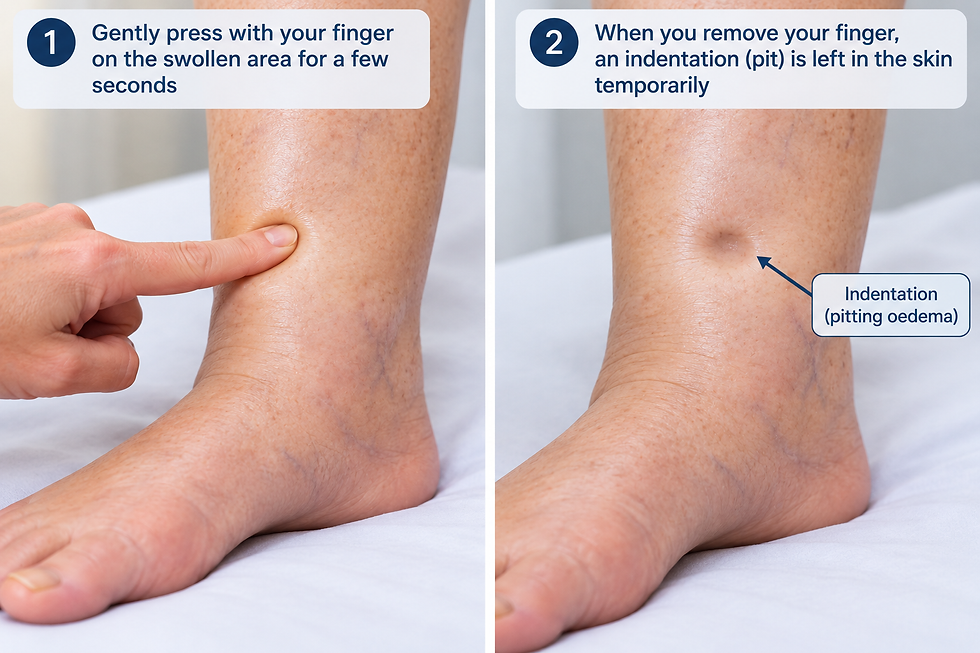
Pitting is common in dependent oedema, venous insufficiency and many forms of systemic fluid retention, including heart failure. It can also occur in early lymphoedema. As lymphoedema becomes more established and the tissues thicken, the swelling may become non-pitting.
Non-pitting oedema means that pressing the tissue does not leave a lasting indentation. It may occur in established lymphoedema and certain other conditions, but it is not a diagnosis in itself.
The crucial point is that pitting tells you something about the physical characteristics of the swelling, not its cause. You cannot establish whether somebody has heart failure simply because their ankles pit, and the absence of pitting does not rule out a significant medical problem.
You can document whether oedema is pitting or non-pitting, where it occurs, whether it affects one or both legs, and how far up the leg it extends. If appropriate, you can also measure the circumference of the limb at consistent landmarks to monitor change over time. These observations are useful for communicating with the GP, but they need to be interpreted alongside the history and other clinical findings.
10. How do you tell the different types of swelling apart?
The following table is a practical starting point. These are common patterns, not definitive diagnostic rules, and more than one cause may be present in the same person.
Possible cause | Typical pattern or clues | What to consider |
Dependent oedema from immobility | Often both ankles; worse after sitting with feet down; may improve overnight | Ankle movement, walking where safe, elevation and review if persistent |
Chronic venous insufficiency | Longstanding ankle swelling, heaviness, varicose veins, brownish skin changes or venous ulcers | Elevation, movement, skin care and clinically assessed compression |
Heart failure or systemic fluid overload | Often both legs; may include rapid weight gain, breathlessness, reduced exercise tolerance or abdominal swelling | Prompt medical review; emergency assessment if severe breathlessness |
Kidney or liver disease | Bilateral swelling, sometimes with facial or abdominal swelling and other systemic symptoms | Medical assessment and investigation |
Lymphoedema | Persistent swelling, sometimes involving the foot and toes; may become firm or cause skin thickening | Specialist assessment, compression where appropriate, exercise and skin care |
Medication-related oedema | Often bilateral; may follow starting or increasing a medicine | Prescriber review; do not stop medication independently |
Deep vein thrombosis (DVT) | Often new swelling in one leg, sometimes with pain, warmth or colour change | Urgent assessment; do not assume it is ordinary dependent oedema |
Infection, such as cellulitis | Redness, warmth, pain and sometimes fever or feeling unwell | Prompt medical assessment and treatment |
Sources: NHS oedema guidance, NHS DVT guidance and NHS lymphoedema guidance.
11. What actually helps? Elevation, ankle pumps, walking and compression
The best treatment depends on the underlying mechanism. For many people with dependent or venous oedema, a combination of movement, elevation and appropriately assessed compression can help. For fluid overload caused by heart failure or kidney disease, these measures may be useful as part of a broader plan, but they do not replace medical treatment.
Elevation: why raising the legs helps
When somebody sits with their feet on the floor, gravity increases the pressure in the veins of the lower legs. Raising the legs reduces this gravitational effect and can help fluid return towards the circulation.
For uncomplicated dependent oedema, elevating the legs on a footstool or pillows during periods of rest can reduce swelling and discomfort. The legs should be supported comfortably, with the heels and skin protected from prolonged pressure. If possible, the feet should be raised sufficiently to reduce the effects of gravity rather than simply resting on a low footstool.
For a person who spends most of the day in a chair, regular periods of elevation may be helpful. However, the benefit may be temporary if they then return to sitting with their legs down for several hours. Elevation works best alongside regular position changes and movement.
For people with venous insufficiency, elevation can reduce venous pressure and may help swelling settle. For established lymphoedema, it can help to some extent, particularly earlier in the condition, but it is rarely sufficient as the only treatment.
There is an important caution with suspected or known heart failure: if lying flat makes someone breathless, do not try to manage this simply by putting them flat in bed with their legs elevated.
Breathlessness when lying flat can be a sign of heart failure deterioration and needs medical assessment. Prioritise a position in which the person can breathe comfortably and seek appropriate clinical advice.
Should you elevate the legs in bed?
Elevating the legs while someone is in bed can be helpful, particularly if they have dependent or venous oedema. A suitable pillow or leg support may raise the lower legs, provided it does not create excessive pressure behind the knees or on the heels.
For a person with limited mobility, positioning needs to be individualised. Check that the hips, knees and ankles are comfortable, that the skin is protected, and that the person can tolerate the position. Long periods of pressure on the heels can cause skin damage, particularly in people with fragile skin, reduced sensation or poor circulation.
Some people benefit from raising the foot end of the bed, but this is not suitable for everyone. It may be difficult to tolerate, and people with breathlessness when lying flat may need the head of the bed raised instead. Raising the entire foot end can also cause discomfort or alter the person's position in bed. The aim is to find a safe, comfortable position that reduces dependency without compromising breathing, skin integrity or comfort.
Ankle pumps: why such a simple exercise can help
Ankle pumps involve moving the foot up towards the shin and then pointing it down again. These movements activate the calf muscles and can help support venous return and lymphatic drainage.
For somebody who is unable to walk regularly, ankle pumps are a useful way to activate the calf muscle pump while sitting or lying down. They can be particularly helpful during prolonged sitting, provided the person can perform them safely and without significant pain.
The movement should be comfortable and controlled. The person can alternate between pulling the toes towards them and pointing them away, repeating the movement regularly throughout the day. The exact number of repetitions matters less than making movement frequent and appropriate to the individual's ability.
Ankle pumps are not a treatment for every cause of oedema. They will not correct significant fluid overload from heart failure, remove a blood clot or reverse advanced venous disease on their own. They are best viewed as one component of a wider management plan.
Walking and general movement: often more useful than isolated ankle exercises
Walking activates the calf muscles repeatedly and helps venous return. For people who can walk safely, short, frequent walks may be more useful than one long walk followed by several hours of inactivity.
For a person who is frail or has reduced mobility, movement may need to be adapted. This could include repeated sit-to-stands where safe, supported standing, short walks with an appropriate walking aid, seated marching or assisted ankle movements. The aim is to reduce prolonged dependency and activate the muscles as regularly as the person's health and functional ability allow.
For somebody who is hoist-dependent or unable to stand, regular changes of position and assisted lower-limb movement may still be helpful. However, the effect will depend on their muscle activity, underlying circulation and the cause of the swelling. Movement should be tailored to the person rather than prescribed as a generic solution.
If swelling is new, one-sided, painful or associated with warmth and redness, do not start an exercise programme on the assumption that it is ordinary dependent oedema. Arrange appropriate medical assessment first.
Compression stockings: when do they help?
Compression stockings apply external pressure to the lower leg. When appropriately selected and fitted, they can help reduce the diameter of superficial veins, support venous return and limit the accumulation of fluid in the tissues.
They are commonly used in chronic venous insufficiency and lymphoedema, and may be helpful for selected people with persistent dependent oedema. In lymphoedema, compression is often combined with exercise and skin care as part of a structured treatment programme.
However, compression is not appropriate for everyone. Before recommending it, consider the person's arterial circulation, skin integrity, sensation, limb shape, ability to tolerate the garment and overall medical condition. Significant peripheral arterial disease can make compression unsafe, and people with unstable or decompensated heart failure need clinical assessment before compression is initiated or intensified. (NICE guidance on arterial circulation and compression)
For someone with diabetes, neuropathy, fragile skin, a leg ulcer or suspected poor arterial circulation, particular care is needed. A clinician may need to assess arterial blood flow, sometimes using an ankle-brachial pressure index (ABPI) or other vascular tests, before deciding on the appropriate level of compression.
Compression stockings should be correctly sized and fitted. A poorly fitting garment can roll down, create pressure points, damage the skin or cause discomfort. If the person develops new pain, numbness, colour change, cold toes or skin damage after applying compression, remove the garment if safe to do so and seek prompt clinical advice.
The practical rule is not to prescribe compression simply because a leg is swollen. First establish whether it is likely to be appropriate and whether further assessment is needed.
12. Water tablets: which types of oedema respond to diuretics?
Water tablets are medicines called diuretics. They act on the kidneys to increase the amount of salt and water excreted in urine. They are useful when excess fluid retention is contributing to a person's medical condition, but they are not a universal treatment for swollen ankles.
In heart failure, diuretics can help relieve congestion and fluid retention. Depending on the person's condition, they may reduce swelling in the legs, abdominal congestion and breathlessness associated with fluid overload. The dose is adjusted by the treating clinician according to symptoms, fluid status, kidney function and other clinical factors. (NICE chronic heart failure guidance)
Diuretics may also be used for fluid retention associated with certain kidney or liver conditions. These situations require individual medical management, often including blood tests and monitoring of electrolytes and kidney function.
By contrast, uncomplicated dependent oedema caused by sitting with the legs down does not usually require water tablets. The primary problem may be gravity, limited muscle activity and raised venous pressure, rather than excess fluid throughout the body. Movement, elevation and, where appropriate, compression are generally more relevant.
Similarly, established lymphoedema is not usually treated with diuretics alone because the main problem is impaired lymphatic drainage. Medication-related ankle swelling, such as that caused by amlodipine, may also respond poorly to diuretics if there is no underlying fluid overload. The prescriber may instead consider adjusting the medicine or using an alternative treatment.
Why does this distinction matter? Diuretics can cause dehydration, low blood pressure, electrolyte disturbances and changes in kidney function. Giving them to someone who does not have an appropriate indication may cause harm without resolving the underlying problem.
If you see a patient with swollen ankles who is not prescribed a diuretic, that does not automatically mean they need one. Equally, if somebody is already taking a diuretic and their swelling is getting worse, they may need a medical review rather than simply increasing the dose.
Never recommend that a patient starts, stops or changes their dose independently.
13. When should you ask the GP to review the swelling?
The most useful question is whether the swelling is new, worsening, unexplained or associated with other changes in health.
A routine GP review is appropriate when swelling persists for several days without a clear explanation, repeatedly returns, becomes progressively worse, or does not improve with reasonable measures such as movement and elevation. Review is also appropriate if the person has known heart, kidney or liver disease, develops new swelling after a medication change, or has skin changes suggesting chronic venous disease.
A more urgent assessment is needed if one leg becomes newly swollen without an obvious explanation, particularly if there is calf or thigh pain, warmth, redness or colour change. These features may indicate a DVT, and urgent assessment is needed rather than trying to treat the swelling with exercises or compression at home.
New, severe or rapidly worsening swelling also needs prompt assessment. The same applies to swelling associated with a hot, red, painful leg, fever or feeling generally unwell, as infection such as cellulitis may be responsible.
If swelling occurs alongside increasing breathlessness, reduced exercise tolerance, difficulty lying flat, rapid weight gain or abdominal swelling, consider possible fluid overload and arrange prompt medical review. Severe breathlessness, chest pain, coughing up blood, collapse or marked confusion requires emergency assessment.
The NHS provides a useful overview of when to seek urgent help for oedema: NHS – Swollen ankles, feet and legs.
14. A practical approach for community physiotherapists
When you visit a patient with swollen lower limbs, it helps to work through a consistent assessment rather than immediately reaching for ankle pumps or elevation.
Start by establishing the history. When did the swelling begin? Is it new or longstanding? Does it affect one leg or both? Is it worse later in the day? Does it improve overnight? Has the person's mobility changed? Have they recently been unwell, had surgery, travelled for a long period or started a new medication? Do they have a history of heart failure, kidney disease, liver disease, venous disease or lymphoedema?
Next, ask about associated symptoms. Has their breathing changed? Are they more breathless when walking or lying flat? Have they started sleeping with extra pillows? Have they gained weight quickly? Are they passing urine as usual? Is there pain, redness, warmth or tenderness in the leg? Are there any new skin wounds or signs of infection?
Observe the swelling and compare both legs where possible. Note the distribution, whether the feet and toes are involved, the skin colour and condition, whether the tissue is pitting or non-pitting, and whether there are signs of venous disease or infection. Consider the person's mobility, ability to move their ankles, usual seating position and how long they spend with their legs dependent.
If you have appropriate training and the equipment, record relevant observations such as respiratory rate, oxygen saturation, pulse and blood pressure. A normal reading does not rule out heart failure or another serious cause, but abnormalities may help establish the urgency of assessment. If you are concerned about acute deterioration, do not delay escalation while trying to complete a full assessment.
Then decide whether conservative management is appropriate. If the presentation is longstanding, stable and consistent with dependent oedema, and there are no concerning features, you may be able to recommend regular position changes, comfortable elevation, ankle movements and safe walking as part of the rehabilitation plan. Compression should only be considered once it is clinically appropriate.
If the cause is unclear, the swelling is new or worsening, or there are signs of a systemic condition, arrange medical review. If there are signs of a DVT, infection or acute heart failure, escalate according to the urgency of the presentation.
Document the findings clearly. For example, rather than writing simply "bilateral oedema present", record when it began, the extent and distribution, whether it is pitting, associated symptoms, relevant changes in mobility, and what action you have taken. This makes it easier for the GP to assess the situation and determine whether further investigations or medication review are needed.
15. Putting it all together: three examples
Example one: the person who sits in a chair all day. An older person has mild swelling around both ankles, worse by the afternoon. They spend most of the day sitting with their feet down, have very limited ankle movement, and the swelling improves overnight. They have no new breathlessness, chest symptoms, pain or sudden deterioration. This pattern is consistent with dependent oedema, although the cause should still be reviewed if the swelling is new or persistent. If clinically appropriate, regular movement, ankle pumps, elevation and changes to their sitting routine may help.
Example two: the person with swollen ankles who is becoming breathless. Another patient has developed worsening swelling in both legs over several days. Their family report that they are more tired, have gained weight quickly and now need several pillows to sleep comfortably. This raises concern about possible fluid overload and heart failure. The appropriate response is prompt medical assessment, not simply more ankle pumps or stronger compression. If they are severely breathless at rest, call 999.
Example three: the person with one newly swollen leg. A patient has developed swelling in one calf over the last day, with discomfort and warmth. They have recently been much less mobile. Although immobility can cause dependent swelling, this presentation raises concern about a DVT. They need urgent medical assessment. Do not assume that elevation, massage, exercise or compression is sufficient.
These examples illustrate why it is important to look at the whole person rather than the swelling alone.
The key message
Oedema is a sign, not a diagnosis. Gravity and immobility can contribute to swelling, but so can venous insufficiency, lymphatic dysfunction, medication effects, heart failure, kidney disease, liver disease, infection and blood clots.
Movement, ankle pumps and elevation can be useful when swelling is related to dependency or venous problems. Compression can be effective for selected patients, but circulation and medical stability must be considered. Diuretics are useful for appropriate causes of fluid retention, particularly congestive states, but they are not a general treatment for all swollen legs.
The most important skill is recognising when swelling fits a familiar, stable pattern and when it represents a change that needs investigation. New swelling, worsening swelling, one-sided swelling, skin changes, breathlessness, rapid weight gain or a general deterioration should prompt you to reconsider the cause rather than automatically treating it as immobility-related oedema.
For patients and carers, the message is simple: if swelling is unexplained, persistent or worsening, ask a healthcare professional for advice. If it is accompanied by severe breathlessness or chest pain, seek emergency help.
This blog is for education and does not replace individual medical assessment. It is not possible to reliably determine the cause of oedema from appearance alone.


Comments