
Radial Head Fractures: What You Need to Know About Recovery and Rehabilitation
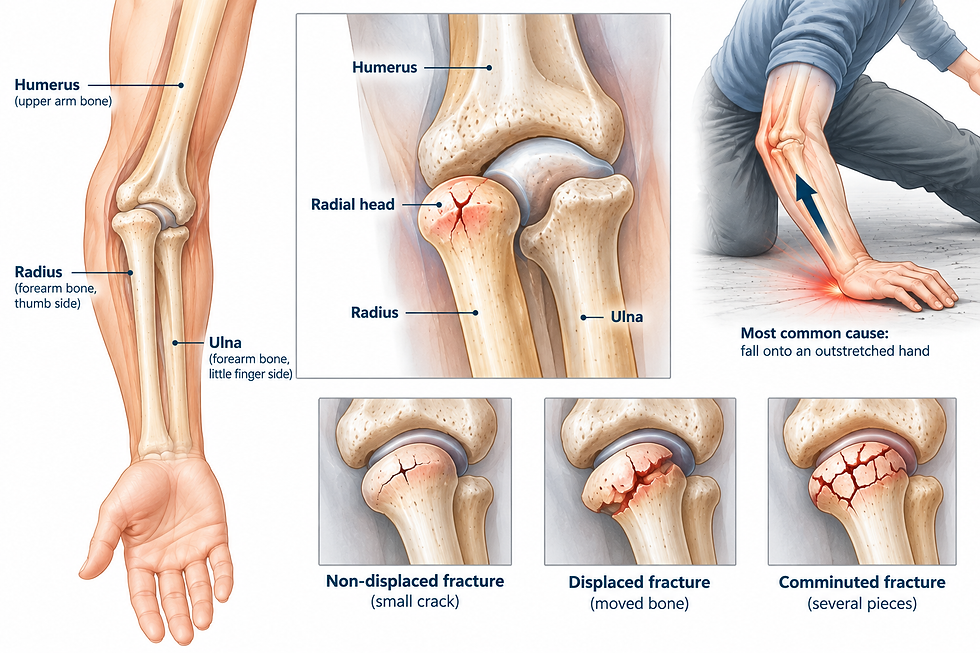
A radial head fracture is a relatively common injury around the elbow. It can be confusing because you may be told that you have fractured your elbow, but the actual fracture is in the upper end of one of the two bones in your forearm.
For many people, radial head fractures heal well and people return to normal function. However, the elbow can become stiff surprisingly quickly, and the rehabilitation advice you receive can be quite specific depending on the type and severity of your fracture.
One of the most important things to understand is that not all radial head fractures are the same. Your consultant or fracture clinic will use your X-rays, your examination and sometimes further imaging to decide how much you can move, lift or load through the arm and when it is safe to progress your rehabilitation.
What is the radial head?
The radius is one of the two long bones in your forearm. The other is the ulna. The radial head is the rounded end of the radius closest to your elbow, sitting on the outside of the elbow joint.
It forms part of the elbow joint and is important for both bending and straightening the elbow and for rotating the forearm. When you turn your palm upwards or downwards, the radius rotates around the ulna, and the radial head is involved in this movement.
The radial head also plays an important role in transmitting forces through the arm and contributing to the stability of the elbow. This is one reason why an injury in this area can affect more than simply bending and straightening your elbow.
How does a radial head fracture happen?
The most common mechanism is a fall onto an outstretched hand. When you instinctively put your hand out to protect yourself, the force from the ground travels up through your wrist and forearm towards your elbow. The radial head can be compressed against the other structures within the elbow, resulting in a fracture.
This can happen during a relatively straightforward fall, but radial head fractures can also occur as part of a more significant injury. The severity can range from a small, stable crack through to a more complex fracture where the bone has moved, broken into several pieces or is associated with damage to other structures around the elbow.
This is why two people who have both been told they have a radial head fracture may receive very different rehabilitation instructions.
Why is the radial head vulnerable?
The radial head sits in a position where it receives a significant amount of force when someone falls onto their hand. It also forms part of a joint and needs to move smoothly to allow the forearm to rotate.
This combination means that an injury can affect both the bone itself and the movement of the elbow. The elbow is also particularly prone to becoming stiff after injury, especially if it is kept still for a prolonged period.
This creates an important balance during recovery. The fracture needs enough protection to allow it to heal, but excessive immobilisation can result in stiffness and loss of movement.
What does "non-weight bearing through the arm" actually mean?
This is an instruction that can be surprisingly easy to misunderstand.
If your consultant has told you that your injured arm is non-weight bearing, this generally means you should not use that arm to support your body weight or take significant load through the elbow.
For example, you should not push yourself up from a chair using the injured arm. You should avoid using the arm to push up from the bed, floor or another surface, and you should not lean heavily through the elbow or hand.
It can also mean that you cannot simply use your usual walking aid.
A standard walking stick requires you to put weight through your hand and arm. A crutch does the same, and a conventional wheeled Zimmer frame requires you to support some of your body weight through your upper limbs. If you have been specifically told that you are non-weight bearing through your injured arm, these walking aids may therefore not be appropriate.
For some people, a gutter frame or gutter walker may be a more suitable option because it can allow weight to be supported through the forearm rather than requiring the person to grip and push through the hand and wrist. However, the appropriate walking aid needs to be assessed and fitted for the individual, and you should follow the advice of your physiotherapist, fracture clinic or consultant.
If you are unsure what "non-weight bearing" means for you, it is worth asking rather than assuming. Something as simple as repeatedly pushing up from a chair can place considerably more load through the injured arm than you might realise.
Why does my consultant decide when I can start doing more?
It can sometimes seem frustrating when you feel that you are ready to do more but are told to wait.
The reason is that the consultant is making decisions based on the specific characteristics of your fracture. They will consider factors such as where the fracture is, whether the bone has moved, how many pieces are involved, whether the joint surface is affected and whether there are associated injuries around the elbow.
Your consultant will also consider your X-rays and how your injury is progressing clinically.
A small, stable fracture may be managed very differently from a displaced or more complex fracture. Some people are encouraged to begin gentle movement very early, while others may have specific restrictions on movement, lifting or weight bearing.
It is therefore important not to compare your rehabilitation with somebody else's. Their fracture may simply be different from yours.
Why are X-rays so important?
X-rays help the medical team understand the location and severity of the fracture. They can show whether the radial head has remained in a good position or whether there has been displacement or another associated problem.
In more complicated injuries, further imaging such as a CT scan may sometimes be required to understand the fracture in greater detail.
Follow-up imaging may also be used when the consultant needs to assess healing or make decisions about progressing treatment. Not every simple radial head fracture requires repeated X-rays, so the timing and need for further imaging will depend on the individual injury.
The important point is that rehabilitation should be based on your fracture and your clinical progress, rather than a generic timetable found online.
What exercises might I do?
Once your consultant or fracture clinic is happy for you to begin moving the elbow, gentle movement is usually an important part of recovery.
The elbow can become stiff very quickly, so rehabilitation often focuses initially on restoring movement rather than building strength.
Depending on the advice you have been given, exercises may include gently bending and straightening the elbow, turning the palm upwards and downwards to work on forearm rotation, and maintaining movement in the wrist, hand and shoulder.
For example, you may be asked to slowly bend and straighten the elbow within a comfortable range. You may also practise turning the palm towards the ceiling and then towards the floor while keeping the upper arm relatively still.
These exercises are usually best performed little and often rather than forcing the joint through a large movement in one session.
Do not forcefully stretch the elbow. Some discomfort during rehabilitation can be normal, but aggressive stretching can increase pain and irritation and may not help recovery.
The exact exercises, timing and number of repetitions should be guided by your fracture clinic or physiotherapist, particularly if your fracture is displaced, complex or has required surgery.
Which movements can be difficult after a radial head fracture?
One of the most noticeable problems can be difficulty fully straightening the elbow. You may also find that bending the elbow is restricted initially.
Forearm rotation can also be affected. This is the movement that allows you to turn your palm upwards and downwards. Everyday activities such as turning a door handle, using cutlery, washing your face, using a screwdriver or carrying objects can therefore feel surprisingly difficult.
You may also notice weakness in the arm because you have naturally been protecting it. The muscles around the elbow, forearm and shoulder may become weaker while you are using the arm less.
This is why rehabilitation generally progresses from restoring movement towards rebuilding strength and function.
How long does a radial head fracture take to recover?
There is no single recovery time that applies to everyone.
Many straightforward radial head fractures heal over approximately 6–12 weeks, although symptoms and stiffness can take considerably longer to settle. Some NHS guidance notes that pain may take around three to six weeks to settle, while the elbow can continue improving for several months.
For some people, the elbow may feel slightly different for quite a while after the fracture has healed. Full functional recovery can continue for many months, particularly where there has been significant stiffness or a more complex injury.
The important thing is to think of recovery as a gradual process rather than expecting the elbow to suddenly feel normal when the bone has healed.
Will I have problems with my elbow permanently?
Most people with straightforward radial head fractures recover well and return to normal or near-normal function.
However, some people are left with a small reduction in movement, particularly a little loss of full elbow extension. This does not necessarily cause any meaningful functional problem.
More significant or complex fractures can have a greater risk of ongoing stiffness, weakness, pain or other complications. The likelihood depends on the severity of the original injury and whether other structures around the elbow were damaged.
The elbow is particularly susceptible to stiffness, which is why appropriate movement and rehabilitation are so important. At the same time, rehabilitation needs to respect the healing fracture and any restrictions placed by the consultant.
When can I start lifting things?
This is another area where there is no universal answer.
Initially, you may be advised to avoid lifting with the injured arm or to keep lifting very light. As healing progresses, the amount of load can gradually increase.
It is important not to jump from doing almost nothing to carrying heavy shopping bags, lifting weights or returning to the gym simply because the pain has improved.
Bone healing and recovery of strength do not necessarily happen at exactly the same rate. Your consultant or physiotherapist can guide you through the progression from normal daily activities to heavier lifting and, eventually, more demanding exercise.
What about using my arm for everyday activities?
As your fracture heals, you will normally gradually start using the arm more for everyday activities, within the restrictions you have been given.
Initially, this might mean using the hand for light activities while avoiding lifting, pushing and pulling. Over time, you can usually begin to incorporate more normal tasks.
Your rehabilitation should be functional. Rather than simply performing exercises, the aim is to help you get back to the activities you need and want to do — whether that is cooking, driving, gardening, working, exercising or returning to sport.
What if I need a walking aid?
This can be particularly important for someone who has also injured their leg or who already has reduced mobility.
If you normally use a stick, crutch or Zimmer frame, but have now been told not to put weight through your injured arm, you should not simply continue using it without checking first.
Your physiotherapist can assess your mobility and consider alternative options. A gutter frame may sometimes allow you to walk while reducing the amount of load placed through the injured hand and wrist, but this is not appropriate for everyone and should be assessed individually.
In some situations, other strategies may be needed to keep you safe while your arm heals.
What can I do to help my recovery?
The most useful thing you can do is follow the specific advice given to you by your fracture clinic or consultant.
Keep the elbow moving when you have been advised that it is safe to do so, complete your exercises regularly and gradually increase activity rather than trying to make up for lost time.
Good pain management can also make it easier to move the elbow comfortably. If you smoke, stopping can also support bone healing.
Most importantly, listen to your body and communicate with your clinical team if your pain, swelling or function is not progressing as expected.
When should I seek further advice?
You should contact your fracture clinic or healthcare professional if your symptoms are worsening rather than gradually improving, if you are struggling to follow your restrictions, or if you are unsure about what activities or walking aids are safe.
It is particularly important to ask for clarification if you have been given instructions such as "non-weight bearing" but are unsure whether that means you can use a walking stick, frame or other mobility aid.
The key message
A radial head fracture can be a frustrating injury because the elbow often feels stiff and weak for longer than you might expect.
The good news is that many people make a very good recovery. The key is finding the right balance between protecting the fracture and restoring movement.
Your consultant's assessment and X-rays help determine what is safe for your particular injury. Once you are cleared to move, regular gentle exercise and a gradual return to normal activity can help restore your movement, strength and confidence.
If you have been told not to put weight through the arm, remember that this means more than simply avoiding heavy lifting. Pushing up from a chair, leaning through the arm or using a standard stick, crutch or Zimmer frame can all place significant load through the injured upper limb.
With the right advice, appropriate protection and progressive rehabilitation, most people can gradually return to their normal activities.
About Physio at Home
At Physio at Home, we believe physiotherapy should be personal, practical and centred around the individual. We bring experienced physiotherapy and rehabilitation into your own home and community, helping you regain mobility, strength, confidence and independence following illness, injury, surgery or a fall. Ben Proctor and Hannah Trebilcock are HCPC-registered physiotherapists with over 35 years’ combined experience, providing friendly, individualised support designed around you, your goals and your everyday life.


Comments